 A virtual photo does not replace Professional Staging
Christine Rae, Founder & President CSP International Staging Business Academy
This week I read another comparison of virtual staging and what was described as “traditional staging,” a term that carries the implication that professional physical staging is somehow old-fashioned. The article concludes that, for most vacant properties, virtual staging offers the strongest combination of affordability, speed, flexibility and online marketing value.
I believe we are asking the wrong question.
This is not about whether virtual staging is good or bad. Technology has an important place in real estate marketing, and virtual staging can be an effective tool when it is used appropriately and transparently.
But let’s get confused here; virtual staging and professional property staging are not two versions of the same service.
One prepares an image.
The other prepares the property.
That distinction matters.
Staging Is Not Furniture Delivery
Professional staging has somehow become increasingly described as the process of bringing rented furniture, artwork, rugs and accessories into a vacant property.
That is an extraordinarily narrow description of a professional discipline.
A trained professional stager evaluates what the buyer will actually encounter.
Condition. Function. Flow. Scale. Lighting. Focal points. Deferred maintenance. Color. Buyer objections. Room purpose. Sightlines. Storage. Exterior presentation. Existing furnishings. Emotional connection. Photography. And, critically, the experience buyers have when they walk through the door.
Furniture may be one part of the solution. However, it is not the definition of staging.
Professional staging begins before the furniture truck arrives, and in many properties no furniture truck is required at all.
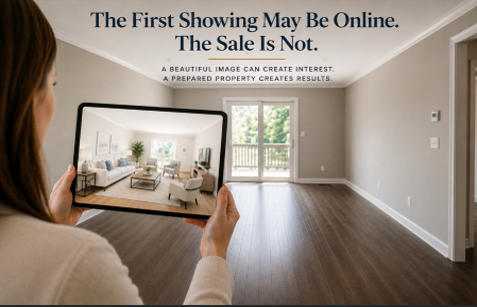
The First Showing May Be Online. The Sale Is Not.
There is no question that online presentation matters.
Buyers need compelling photography to persuade them to take the next step. NAR’s 2025 research found that 31% of buyers’ agents said buyers were more willing to walk through a property they had seen online when it was staged. It also found that 83% said staging made it easier for buyers to visualize the property as their future home.
But notice what happens next. They walk through the property.
The beautifully furnished living room they saw online does not accompany them through the front door when the furniture exists only in the photograph.
They experience the real room.
Its dimensions.
Its light.
Its traffic pattern.
Its condition.
Its sounds… it’s echoes
Its smell.
Its finishes.
Its relationship to the adjoining spaces.
And every discrepancy between the expectation created online and the experience delivered in person has the potential to affect trust and perception.
The objective should not simply be to earn the click.
It should be to ensure that the property fulfills the promise made by the photograph and secures the sale.
“Faster” Needs More Examination
Virtual staging can unquestionably be produced quickly.
But faster to list is not necessarily faster to sell.
Professional property preparation deliberately asks a different question:
Is this property ready to compete before we expose it to the market?
There can be tremendous financial consequences to rushing an inadequately prepared property onto the market simply because photography can be digitally improved in 24 hours.
A virtual sofa cannot correct deferred maintenance.
It cannot improve inadequate lighting.
It cannot address an unappealing paint color throughout the actual property.
It cannot make an overcrowded occupied property easier to move through.
It cannot resolve a confusing room function when the buyer is physically standing inside it.
It cannot improve curb appeal on arrival.
And removing something from a photograph does not remove the buyer objection from the property.
What Does “Cost Winner” Actually Mean?
Virtual staging will almost always be less expensive than physically furnishing a vacant property.
That is hardly surprising.
But the least expensive marketing option and the best investment in protecting seller equity are not the same thing.
The more useful question is not: “Which service costs less?”
It is: “What does this particular property require to support its value, compete effectively and give the seller the strongest possible opportunity in this market?”
NAR’s 2025 Profile of Home Staging reported that 29% of real estate professionals saw a 1% to 10% increase in the dollar value offered when properties were staged. 49% of sellers’ agents reported reduced time on market. Results tracked by stagers is incredibly much higher on all fronts, because we stage all the time not selectively so we see different results, more frequently than real estate agents.
That research does not prove that every property must be physically staged. Nor does it provide a controlled comparison establishing that physical staging will outperform virtual staging in every transaction.
It does, however, make one thing very difficult to dismiss:
Property presentation does affect buyer behavior.
Reducing that decision to the price of a photograph versus the investment in preparing the actual property misses the larger financial question.
Digital Possibility and Physical Reality Must Remain Distinct
There is another reason the distinction matters: truth in real estate marketing.
The National Association of REALTORS® 2026 Code of Ethics and the CREA REALTOR® Code requires REALTORS® to present a “true picture” in advertising and expressly includes Internet content and misleading images within that obligation. California went further on January 1, 2026. AB 723 requires qualifying digitally altered real estate images to be conspicuously disclosed and requires consumers to be provided access to the original, unaltered image.
That does not make virtual staging unethical. In fact, responsible virtual staging companies themselves emphasize appropriate disclosure. But these requirements tell us something important.
The industry recognizes a difference between what has been digitally represented and what physically exists.
We should too.
Virtual Staging Has a Place. BUT it is NOT the same as REAL Property Staging.
Virtual staging may exist as a disclosed digital marketing technique. But digitally furnishing an image does not replace professional property preparation.
It doesn’t. Perhaps it is time to reconsider the terminology itself.
Virtual furnishing? Digital property visualization? Digitally staged imagery?
These terms more accurately describe what is taking place: an image is being altered to illustrate something that does not physically exist in the property.
Professional staging is different. Professional staging takes responsibility for the property buyers actual experience, not simply the image that persuaded them to visit it.
And There Is a Human Side to This Conversation
There is also something uncomfortable about celebrating the elimination of consultants, movers, furniture rental owners, installers, warehouse workers, drivers, & stylists. Removal simply because technology makes those things unnecessary for creating a photograph. Those “logistics” represent real businesses.
Professional stagers are independent entrepreneurs with warehouse employees. Movers. Rental companies. Photographers. Trades. Suppliers. Manufacturers. Local businesses and the families whose incomes depend upon them.
That alone is not a reason to resist technology. Industries must evolve, and professional stagers must evolve with them. But innovation should create greater value, not simply transfer value from a professional service economy to a digital image provider while convincing consumers that nothing has been lost.
Something is lost when the photograph becomes more important than the property.
So, Which One Sells Properties Better?
That question cannot honestly be answered simply by awarding points for speed, convenience, maintenance and price.
The real questions are:
What does this property need?
What will the buyer see online?
What will the buyer experience be when they arrive?
Does the physical property support the value story being communicated through its marketing? And above all:
Are we improving the property, or merely improving the picture of it?
After 25 years in the professional staging industry, I believe technology should make us better at serving sellers and buyers.
It should not persuade us that the physical property no longer matters.
Because ultimately, buyers do not purchase the photograph.
They purchase the property.
Christine Rae
Founder & President, CSP International™
Co-author, Home Staging for Dummies
Professional staging educator and industry advocate













 Subscribe Today!