The Summer Wake-Up Call
A student said something to me today that stopped me in my tracks.
She told me she had to cancel her vacation because she was “so busy” juggling stagings, de-stagings, and two renovation projects. Are you shrugging your shoulders saying “yeah, what is the problem”- you know she’s not alone.
I’ve heard versions of this for years: people missing family events, skipping graduations, postponing time off, and living in a constant cycle of “just get through this week.” They’ll tell themselves they’ll rest after the next install, after the next listing, after the next set of photos. But the next thing always comes.
Summer has a way of bringing this problem into sharp focus. Listings still happen. Moves still happen. Agents still need help. But the pace gets uneven. Scheduling gets messy. People travel. Sellers reschedule. Contractors slip. A “simple” stage turns into three extra trips. Suddenly, you’re running hard and still feeling behind.
This isn’t a work ethic issue. It’s a business structure issue.
The Real Trap: Always working in the staging business, never on the business
Most stagers and decorators start out as one-person businesses. That’s normal. You do the consults, the planning, the shopping, the installs, the admin, the marketing, the invoicing, the follow-up, and the problem-solving. You are the business.
The trouble starts when you stay there too long.
When you’re only working in the business, the business can’t mature. It can’t protect you. It can’t run without you. It can’t give you time back. It can’t grow in a way that feels stable. That’s when people end up “busy” but feeling not in control.
And here’s the hard truth: if you can’t take time off without everything falling apart, you don’t have a business. You have a job with unpredictable hours, that’s not what you had in mind when you started the business. We all remember how addictive it is when we get call after call and as the saying is “be careful what you wish for” -comes true and you have more jobs than you ever dare dream of! AND you can’t say no to that agent with the desperate job- they want YOU!
“Busy” is not the same as sustainable. Let’s talk about what “busy” often hides:
- Too many active projects at once, poor scheduling boundaries (or no boundaries at all)
- No buffer for delays, weather, traffic, seller issues, or contractor changes
- A calendar filled with tasks, but no time for planning, marketing, and follow-up and/or reactive decision-making all day long
It’s not that you’re doing something wrong. It’s that you’re trying to run a professional service business without the operating system it needs.
This is especially true when you’re doing more than one type of work at the same time: staging, de-staging, decorating, project managing the renos before staging. Oh and family life. The second you add additional services; your calendar needs a different level of structure.
The fix starts with one question: what is your true capacity?
Most professionals don’t actually know their capacity. They guess.
They take on three new jobs because the phone rang, then they “figure it out.” That works—until it doesn’t. Capacity is not how many jobs you want. It’s how many jobs you can complete at a professional level without sacrificing your health, your relationships, and your reputation. Here’s a simple way to think about it:
You don’t get paid for being busy. You get paid for completed outcomes.
So, your capacity should be based on what you can reliably complete in a week, not what you can squeeze into a day.
A practical capacity reset: Instead of asking, “Can I fit this in?” ask these:
- How many installs can I do in a week without rushing?
- How many consults can I do without sacrificing planning time?
- How many active projects can I carry before I start dropping balls?
- How many hours am I actually willing to work in a week in July?
That last one matters. If you want a life, you have to plan for one.
Your calendar is your business plan (whether you like it or not)
If you want control, you need a calendar that is designed, not accidental.
The goal is not to fill every hour. The goal is to create a week that can handle reality. We always recommend a small business consider setting up with the software Zoho One. It has 50 applications and literally helps run your business by keeping everything under one roof…project management, calendar, sales, book keeping, social media -client management -everything. Get a free trial of Zoho one here (no credit card required)
Here are the calendar upgrades that make the biggest difference:
1) Put your “invisible work” on the calendar
Stagers and decorators do an enormous amount of invisible work: planning, sourcing, emailing, confirming, invoicing, photo review, vendor coordination, packing, shopping, inventory reset. If you don’t schedule it, you end up doing it at night, on weekends, or in between jobs while stressed. The fastest way to stop the business from eating your life is to claim time for the work no one sees. I always remember a colleague telling me she turned her business cell phone off at 6pm Friday and didn’t open it again until Monday at 10am. I just about fell over- truly, “how do your agents react?” she told me” I train them to call in the hours I am available or they don’t get ME” hmmm that was a great lesson.
A simple standard:
- One block per day for admin/communications
- One block per week for planning the next week
- One block per week for marketing/follow-up (even if it’s short)
This is how you work on the business while still doing the work.
2) Build buffers like a professional
Most schedules fail because they’re too tight. Installs come with delays: elevator waits, condo rules, weather, traffic, seller complications, contractors, access issues. If you schedule back-to-back like a robot, one delay ruins the entire week.
Professional scheduling includes buffers; not because you’re slow, but because you respect reality.
A simple approach:
- No install immediately followed by a consult
- No two major installs on consecutive days without a recovery buffer
- No “late afternoon” install that forces you into night packing
Your time is not infinite. Protect it like inventory.
3) Choose a weekly rhythm and stick to it
One of the fastest ways to reduce overwhelm is to stop reinventing your week.
Example rhythm:
- Monday: Planning & Consults day
- Tuesday/Wednesday: installs (Thursday is overflow if you decide)
- Thursday: admin + follow-up + resets
- Friday: overflow + prep + marketing block
Your exact days will differ. But the point is: a rhythm reduces decision fatigue. Your brain stops re-solving the same week over and over.
The self-care part stagers avoid talking about
Most stagers and decorators are hardworking, service-oriented people. They’ll push through exhaustion because they care about results. Add summer heat, lifting, stairs, driving, and tight timelines do real damage over time.
Taking care of yourself isn’t soft. It’s operational. A few non-negotiables that protect your body and your business:
- Stop scheduling installs without recovery time
- Protect hydration and meals on install days
- Set a hard stop time at least a few days per week
- Don’t stack physical jobs without a reset day
- If you’re consistently wiped out, your schedule is asking for more than your body can deliver
Your business should support your life. Not consume it.
A note for real estate agents reading this
Agents, you’re part of this conversation too.
When stagers are constantly squeezed, the work suffers. The timeline slips. The communication gets short. The experience feels stressful instead of professional.
You want the stager you trust to still be in business next year. That requires sane timelines and clear expectations.
Three small agent behaviors make a huge difference:
- Book staging earlier than you think you need it
- Respect the stager’s process and calendar boundaries
- Stop treating “rush” as normal; rush is expensive, in time and in quality
Good agents protect their professional team. That includes the stager.
The difference between “booked” and “built”
This is the shift I want for you: Being booked is great. But being built is better, and a built business can handle summer. A built business can absorb reschedules, can manage multiple projects and you can take time off without chaos. If you want that, you don’t need a whole reinvention.
You need two things:
1) a clearer capacity limit and 2) a repeatable weekly structure
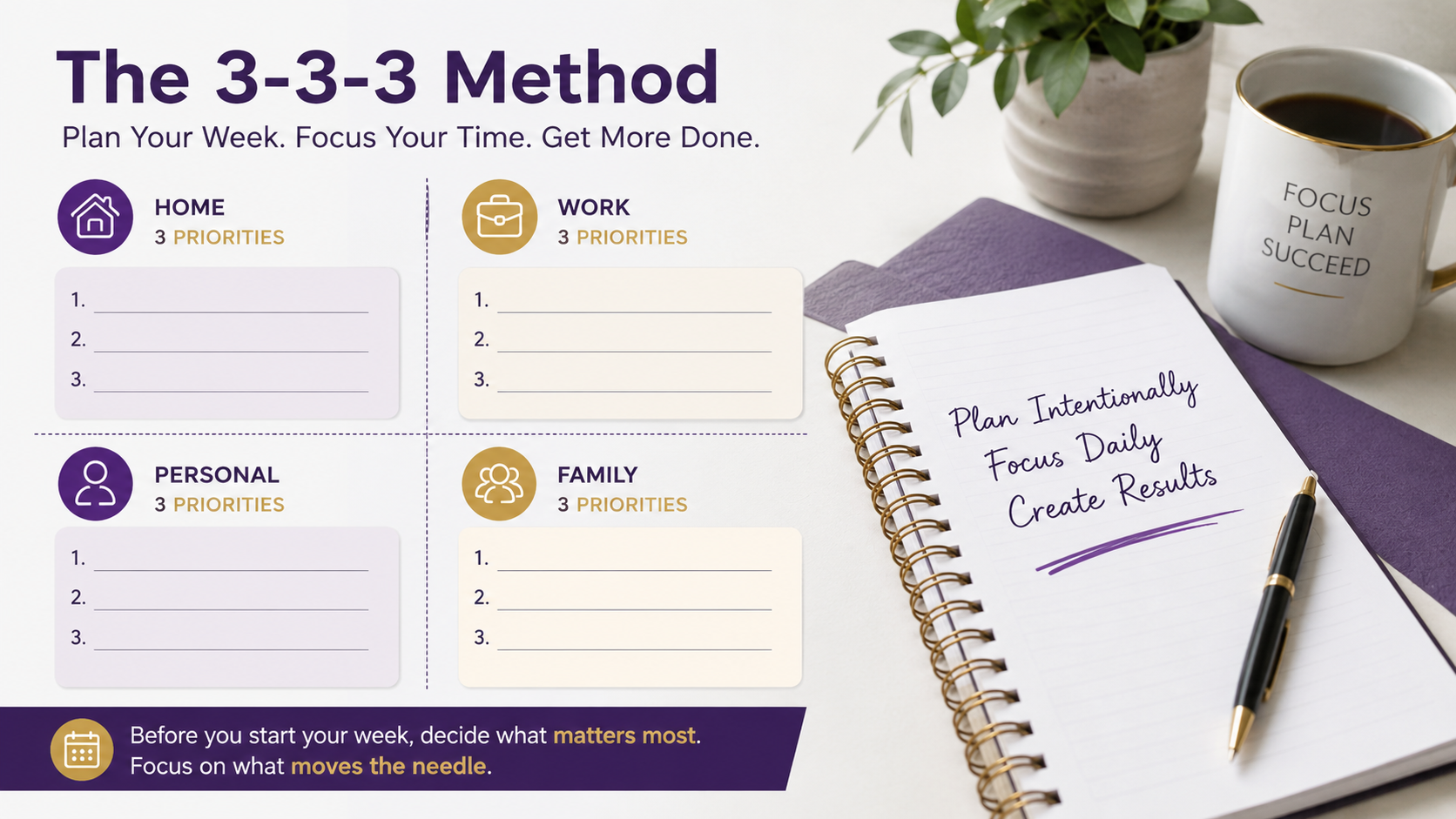
Try the Sunday Evening 3-3-3 Method
 Darren Hardy talks about this as the most important thing he does every Sunday. Select the three most critical tasks to accomplish each day for each of the four areas. Then three tasks that are important but not urgent & secondary to main tasks. Then choose three minor/maintenance tasks that can be completed quickly.
A simple reset you can do this week.
If your schedule is already in motion, here’s the reset that works even mid-season:
 1. Look at the next two weeks only (don’t panic about the whole summer).
2. Identify the three days that are unrealistic.
3. Add one buffer block and one planning block to your week.
4. Decide what you will stop doing after 6:00 p.m. (or whatever time you choose).
5. Choose one day in the next month that is protected time off—then treat it like a client booking.
This is not about perfection. It’s about leadership. You are the CEO of your calendar.
Final thought
If you’re canceling vacations and missing life events because you’re “so busy,” please hear this plainly: that isn’t the cost of success. It’s a signal. A signal that your business needs structure, boundaries, and a rhythm that can support the work you’re doing. Because the goal isn’t to build a business that looks successful from the outside. The goal is to build one you can live inside.
About CSP International & Christine Rae
CSP International is a leading education and business development resource for professional home stagers, interior decorators, and real estate-industry professionals. Through training, courses, tools, and practical business guidance, CSP International helps professionals strengthen their skills, build more profitable businesses, and deliver better results for their clients.
Christine Rae is the founder of CSP International and an internationally recognized educator, speaker, and advocate for the home staging industry. With decades of experience in staging, design, training, and business development, Christine is known for helping professionals move beyond decorating knowledge alone and develop the confidence, systems, and business skills required to succeed.
CSP International provides education for those entering the industry as well as experienced professionals looking to expand their services, improve profitability, strengthen client relationships, and stay current with the changing expectations of real estate and design clients.













 Subscribe Today!