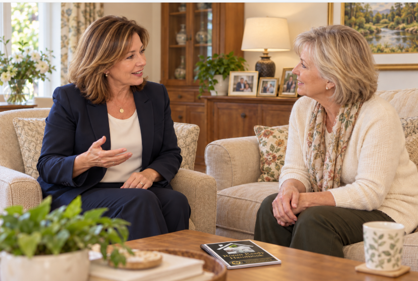
 The appointment is booked. The seller knows you are coming. You arrive ready to assess the property and explain what needs to happen before it goes on the market. But what does the seller think you are there to do? Rearrange the furniture? Choose a paint color? Confirm that everything already looks lovely?
If their understanding of the appointment is different from yours, that difference will influence the conversation before you have made a single recommendation.
This is one reason the occupied staging process we teach at CSP International has 14 steps and begins on the phone. What happens before you arrive deserves as much professional attention as what happens inside the property.
Occupied staging is not a new discovery
Reading some industry social media driven discussions, you could be forgiven for thinking occupied staging has only recently emerged as a service. It has been an important part of staging, in fact it is the seed that germinated the industry and CSP’s foundational teaching, for decades. Yet it is still sometimes treated as a less demanding version of vacant staging. Walk through, offer suggestions, move a few things, and leave the seller with a list. That seriously underestimates the work.
As someone who is a pioneer of the industry, has seen the evolution and done the work I can tell you an occupied consultation can influence how sellers spend their preparation budget, use their available time, and understand what their property needs before going to market. Recommendations may involve improving condition, repairs, cleaning, lighting, finishes, renovation, the use of space, as well as furnishings.
Those decisions require assessment, priorities, and a reason behind each recommendation. If you are going to do it then Occupied staging deserves a professional process.
The property is the assignment
Some stagers hesitate to accept occupied projects because the results may not be “picture perfect.” Existing furniture may be unfashionable. The budget may be limited. The family still needs to function in the space. But whose objective are we serving?
The assignment is to improve the presentation of this property for its intended buyer, within the seller’s circumstances. A photograph for your portfolio is a secondary consideration. A substantial improvement does not become less valuable because the sofa would not have been your first choice.
Working with existing furnishings requires judgment about what to retain, reposition, remove, or supplement. It can demand considerable resourcefulness, along with the confidence to explain when an existing condition/item is undermining the presentation.
Concern about damage to supplemental inventory also deserves a business response. Clear responsibilities, documented condition, appropriate insurance, and a professionally prepared contract help manage that concern. No contract prevents every mishap, but refusing to consider supplemental items may limit what you can achieve. The decision should follow the needs of the project and the terms of your service.
You are working with people as well as property
An occupied property comes with routines, memories, and possessions. The chair interrupting a clear view through the room may be where someone has read every evening for twenty years. The collection filling a cabinet may represent decades of travel or memories of a loved one. You are assessing the property for sale. They are living in it. Both perspectives are present during the consultation, whether anyone acknowledges them or not. Professional judgment includes recognizing that difference. Knowing what should change is only part of the work. Your recommendations need to be understood by the person expected to act on them.
Consider “declutter,” a word used so casually in real estate that people rarely stop to question it. What you intend as practical advice can sound like criticism of someone’s belongings or housekeeping. It is also vague. A seller can spend an entire weekend decluttering and still leave untouched the things you believed needed attention. Real estate agents frequently tell me, “Oh I always tell them to declutter.” I answer. “well, that is a good start, but it is only part of the process”.
In my workshops I teach students the power of the spoken word and declutter is one to avoid. A professional should be able to explain what needs attention and why without labeling the seller’s possessions as clutter. Language matters when cooperation is essential to the result, and a big part of co-operation
Agreement is not the same as readiness
A seller can nod throughout a consultation and still be uncertain about what comes next. They may understand a recommendation but doubt its value. They may agree with the objective while knowing that completing the work will be difficult. They may simply feel uncomfortable saying so. By the time a stager returns to find preparation unfinished, the opportunity to address some of those obstacles may already have passed.
This is why I teach anticipation. Different expectations, abilities, priorities, and levels of attachment are part of working in occupied properties. They should not come as a surprise. No process guarantees that every seller will follow every recommendation. A structured approach can, however, reduce avoidable misunderstandings and help identify obstacles while there is still time to address them. Handing over a list does not establish that the seller is ready to carry it out.
Answers are not the same as an education
Facebook groups, professional associations, and AI can be useful sources of ideas and discussion. Asking questions and exchanging experiences have a place in professional development. But collecting answers as situations arise does not give you a complete process for delivering a service.
A group member responds to the circumstances you describe. AI works with the information you provide, and usually tells you what you want to hear. An important detail may be missing because you did not recognize its significance. The question you are asking after a difficult appointment may concern something that needed attention before it was booked.
Advice can also conflict. Without a sound foundation, how do you decide which answer applies to your client and the responsibility you have accepted?
Professional education should help you connect decisions, anticipate difficulties, and explain your recommendations. It should provide a structure you can apply and adapt, supported by an understanding of why it works. Recently, a colleague offered paid coaching to help a stager develop a business plan after seeing her question in a Facebook group. The offer was dismissed because another stager would provide help for free. There is nothing wrong with colleagues helping one another. But a willingness to share advice does not make structured coaching unnecessary or the person offering it unreasonable for charging. A suggested answer and the time spent helping someone develop, question, and apply a plan are different services. We ask sellers and agents to recognize that our expertise is worth paying for. We need to apply that same principle to developing our knowledge.
The process supports the result
The CSP® 14-step occupied staging process begins with the first telephone conversation because the service begins there. I teach students to anticipate obstacles, establish understanding, and approach the work with a clear structure.
The broader lesson is straightforward: Occupied staging requires preparation, judgment, and the ability to earn cooperation. Its value is not measured by how much furniture arrives or how closely the finished room resembles a magazine photograph. A good eye helps you recognize what the property needs. A professional process helps you work with the people who must make those changes possible.
Christine Rae
Founder & President, CSP International™
Co-author, Home Staging for Dummies
Professional staging educator and industry advocate













 Subscribe Today!